Perspectives
Your place to explore new perspectives on British art from 1900 to now. Through interviews, films, image galleries and essays, we uncover the creative lives of the people behind the art on our walls.
From Cornwall to Switzerland: The travels of Wilhelmina Barns-Graham
[ Artist in Focus, Stories )
Alice Strang explores how travel, both within Britain and in Europe, inspired and developed the work of Wilhelmina Barns-Graham.

Wilhelmina Barns-Graham, St Ives, 1955, Pencil on paper, Pallant House Gallery Chichester (The George and Ann Dannatt Gift, 2011) © The Barns-Graham Charitable Trust
The drawing was part of the George and Ann Dannatt Gift to Pallant House Gallery in 2011. Along with Barns-Graham, George was a member of the Penwith Society of Arts and the Newlyn Society of Artists. Their gift also included Barns-Graham’s painting Geoff and Scruffy of 1956 and the watercolour Glacier of about 1949.
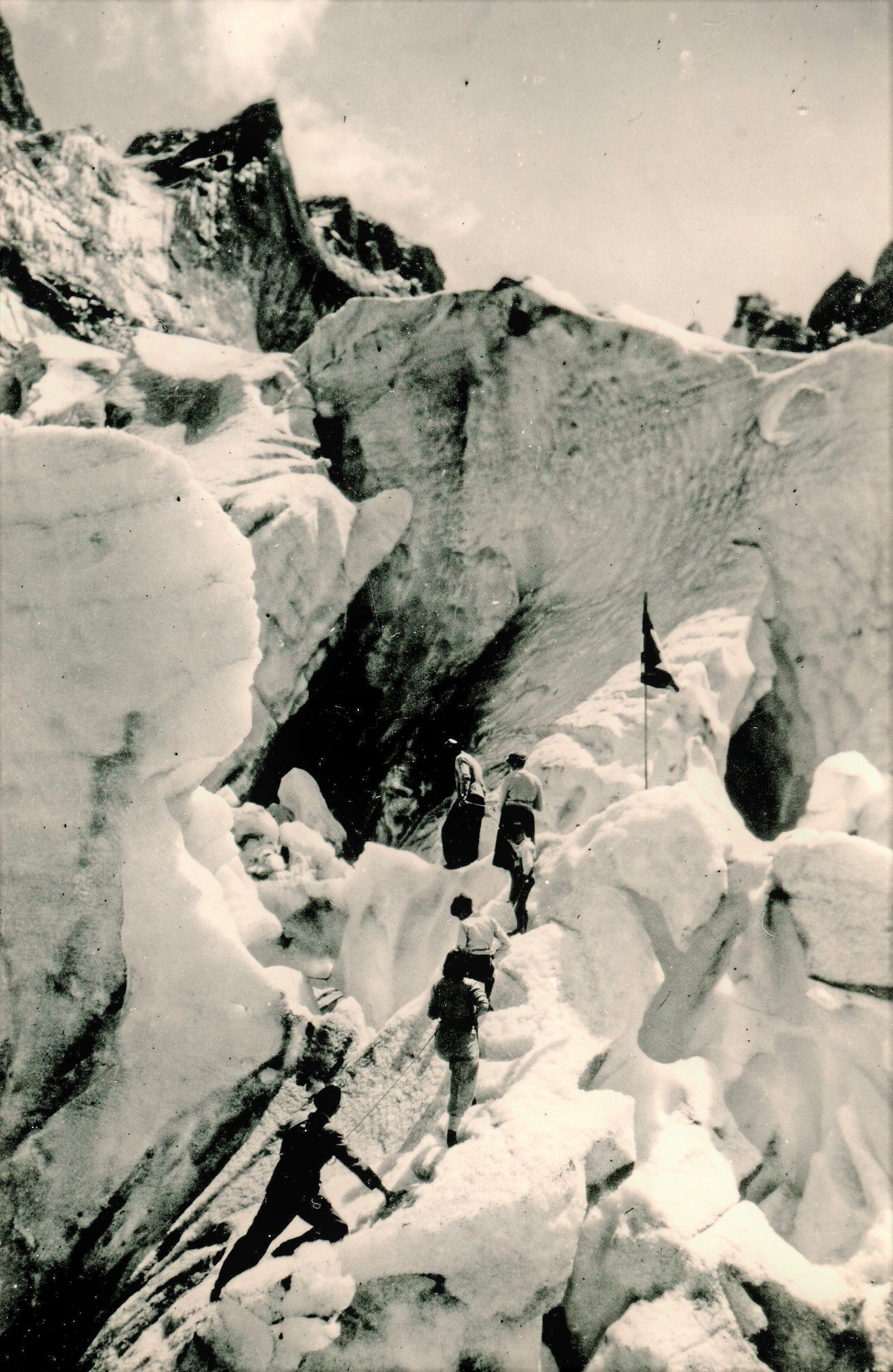
Wilhelmina Barns-Graham (second from left) climbing the Grindelwald Glacier, Switzerland, with the Brotherton family and a guide, May 1949.
Photo © P. N. Brotherton, courtesy of the Wilhelmina Barns-Graham Trust
As Barns-Graham’s professional standing grew, so foreign travel became possible after World War Two. Following a studio visit to see her work, a Mr Brotherton, Deputy Education Officer for Devon, invited Barns-Graham to join him and his family on a trip to Switzerland in May 1949. Whilst there, she spent time climbing and studying the Grindelwald Glaciers (see photo), which had a profound effect on her developing ideas about abstraction.
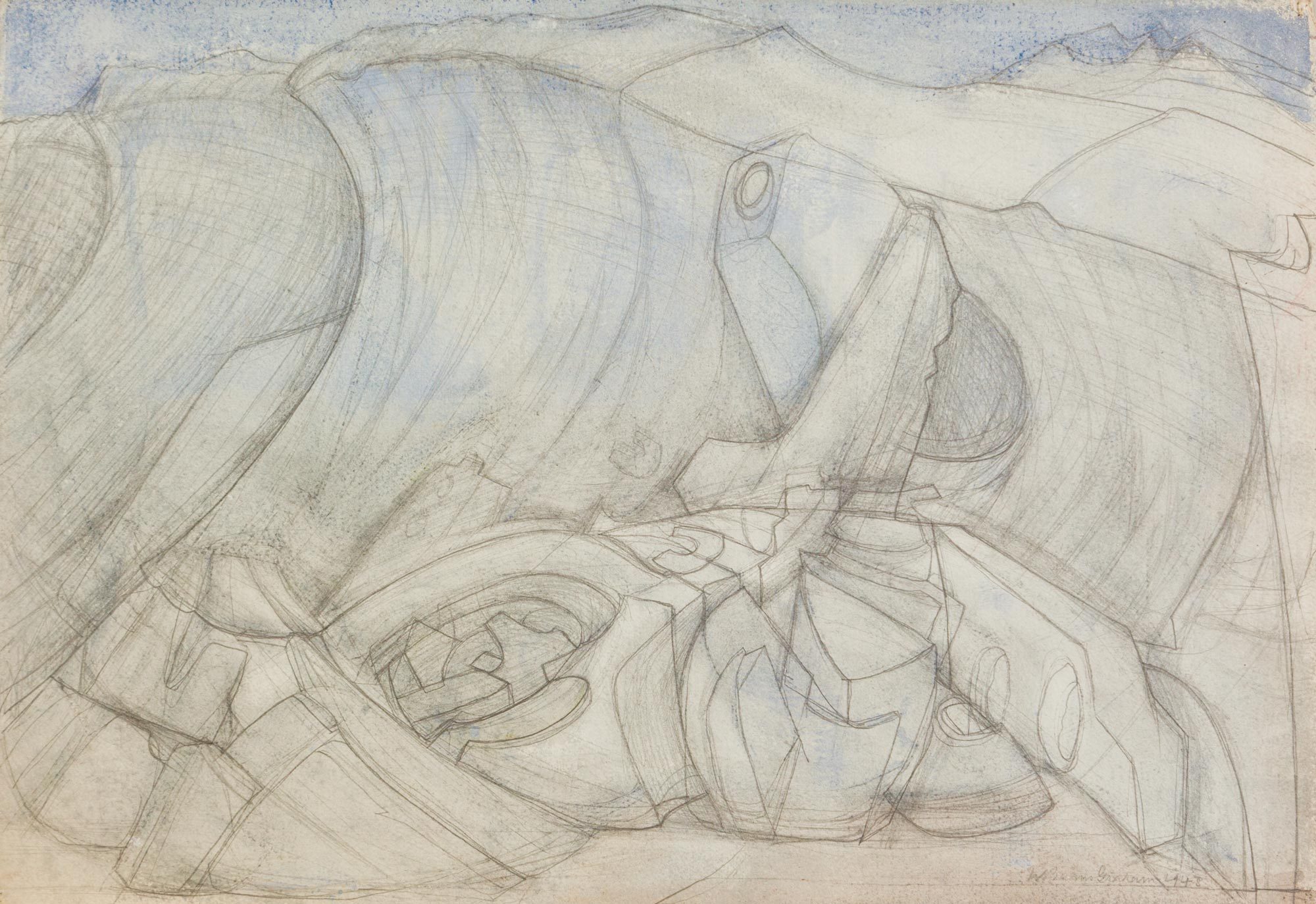
Wilhelmina Barns-Graham, Glacier, c.1949, Watercolour and pencil on paper, Pallant House Gallery, Chichester (The George and Ann Dannatt Gift, 2011) © The Barns-Graham Charitable Trust
Glacier comes from a seminal series of works on paper and paintings in which Barns-Graham attempted to express what she had encountered in Grindelwald. She said of the glaciers: “The likeness to glass and transparency, combined with solid rough ridges made me wish to combine in a work all angles at once, from above, through and all round, as a bird flies, a total experience.”
The abstract forms which combine monumentality with fluidity in Glacier are softened with the use of gentle pencil-markings and delicate washes of blue watercolour. The glacier works proved to be a turning-point in Barns-Graham’s career, not least when her painting Upper Glacier (1950) was purchased by the British Council that year.
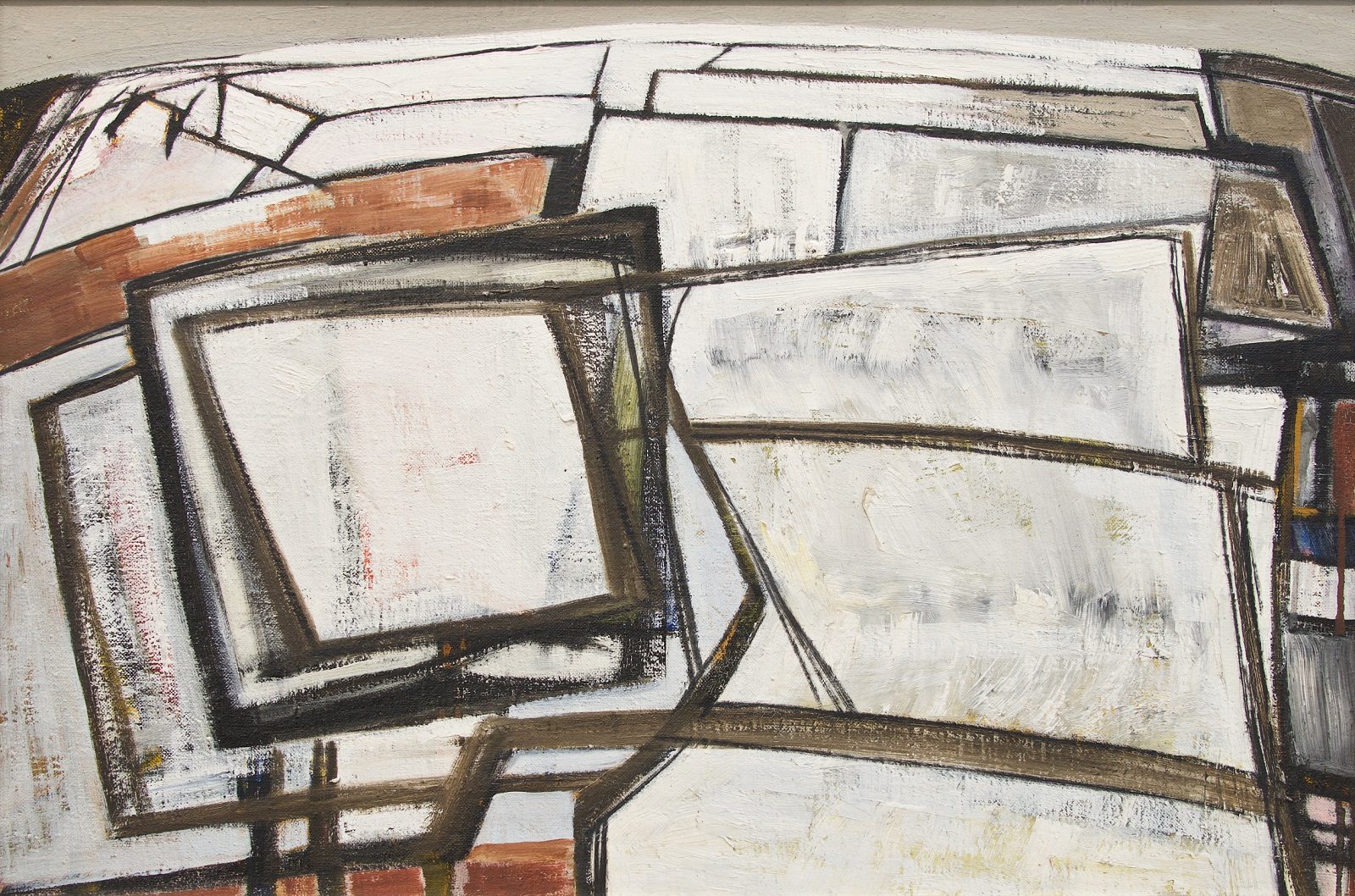
Wilhelmina Barns-Graham, Snow at Wharfdale II, 1957, Oil on canvas, Pallant House Gallery, Chichester (Presented by the Barns-Graham Charitable Trust through the Art Fund, 2015) © The Barns-Graham Charitable Trust
Between 1956 and 1957, Barns-Graham taught part-time at Leeds College of Art. She painted Snow at Wharfedale II (1957) during the winter she spent in Yorkshire. Once more, Barns-Graham responded to her natural environment, in this instance to one of the North Yorkshire Dales. Field boundaries provide the structural basis of a complex, abstract image. The rhythm of layered rectangles describes the lay of the land, whilst a raw technique speaks of the texture of snow and earth, as the dale stretches towards a high horizon and glowering sky.
Snow at Wharfedale II was given to Pallant House Gallery by the Wilhelmina Barns-Graham Trust, through the Art Fund, in 2015, along with the painting Expanding Forms, Touchpoint Series No. 1 (Entrance) of 1980. Set up in 1987 in order to promote her work and to support others to fulfil their potential in the visual arts, the trust became active on Barns-Graham’s death in 2004.
Alice Strang is an award-winning art historian and curator of Modern and Contemporary Art.
This article is indebted to W. Barns-Graham: A Studio Life by Lynne Green (Lund Humphries, Farnham, 2011).